
Reflect on your play
without mistaking it for proof
Complete a 100-item self-report questionnaire, then compare it with experimental gameplay indicators from recent League matches. This is not a clinical or diagnostic assessment.
- Free self-report results
- No credit card to start
- Not a clinical assessment
Key Features
Enter your Riot ID
Saiki uses Riot's supported developer APIs to fetch recent match data. It does not receive your password or chat logs.
Answer 100 self-report items
The questionnaire calculates raw scores across the six HEXACO personality domains from your own answers.
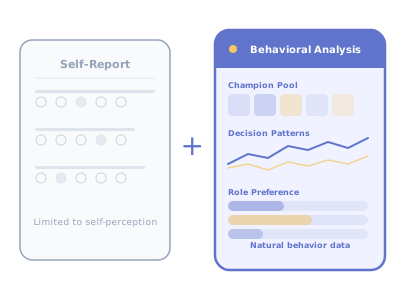
Compare two different signals
See self-report scores beside experimental gameplay indicators. The gameplay values are heuristics, not validated personality scores.
What the free report contains
Saiki turns your answers into six raw domain scores. If you add a Riot ID, it also calculates experimental indicators from recent match statistics.
- Six self-report domain scores on a 0 to 100 display scale
- A transparent list of the match metrics used in each unlocked indicator
- A side-by-side view of agreement or difference, without diagnostic conclusions
What the gameplay layer actually uses
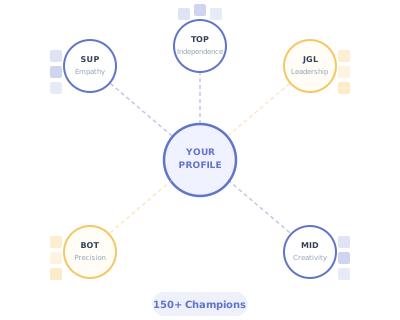
The current rules use champion and role variety, vision, participation, assists, healing, deaths, performance variance, and early-surrender rate. These choices are product heuristics, not population norms.
- Honesty-Humility has no gameplay indicator and remains self-report only
- The Emotionality mapping is explicitly the weakest conceptual match
- Strategic Play reports economy and tempo, not personality or IQ
Two signals, clearly separated
The questionnaire is self-report. The match layer contains experimental gameplay indicators, not validated personality scores.
Read the evidence, including its limits
Paper-by-paper reviews of gaming and cognition, plus a transparent account of what those studies do not establish about Saiki.
September 7, 2025
Gamers and a Moving-Dot Decision Task: What the 2022 fMRI Study Found
In a study of 47 college-age participants, regular gamers were faster and slightly more accurate on a moving-dot task. The small group comparison does not prove broad decision-making ability or validate Saiki.
September 7, 2025
Gaming and the Brain: What a 116-Study Neuroimaging Review Actually Supports
The 2017 review found recurring neural correlates around attention, cognitive control, visuospatial processing, workload, skill learning, and reward. Heterogeneous methods prevent a single gamer-brain conclusion.
September 7, 2025
Gaming and Cognitive Performance in Children: A Careful Read of the 2022 JAMA Study
The corrected JAMA article found very small task-performance differences between children reporting at least 21 gaming hours a week and children reporting none. The study was cross-sectional and did not establish causation.

Start with the self-report
Complete the questionnaire for free. Add a Riot ID only if you also want to inspect Saiki's experimental match-data indicators.
Use the report as a prompt for reflection
Saiki does not diagnose, measure IQ, or replace a qualified assessment. It gives you a structured self-report and a transparent gameplay comparison.
Start FreeNo credit card required • Free forever plan available